

Categories
All Communal service providers Community mobilization

Partner municipalities of the ”MĂ IMPLIC” project are ready for the stage of the plan elaboration for the communal service improvement

Partner municipalities of the ”MĂ IMPLIC” project are ready for the stage of the plan elaboration for the communal service improvement

Thirty localities/groups of localities are implementing in the period 2021-2023 projects designed to improve a communal household service, with the support of the “MĂ IMPLIC” project. During the last eight months, all communities had to realize a complex activity plan, with the voluntary involvement of citizens. Thus, in each community were formed Community Initiative Teams, which actively contributed to the achievement of the proposed goals: creating community consensus on the municipality’s initiative to modernize the communal service, developing the vision of service improvement, identifying the solution, communicating with citizens, conducting awareness campaigns and other.

One of the most important stages was the organization of the workshop on the selection of the service improvement solution. Within it, citizens had to conceptualize the model of the communal service in their locality, including with the support of the technical consultant, delegated by the “MĂ IMPLIC” project. Most communities have completed this activity successfully, which means that majority is ready for the next stage, namely the development of the communal service improvement plan. The plan will include priority objectives and actions, which will contribute to the creation/development of the service.

“Today we notice that the teams are more consolidated, they communicate more efficiently and actively with the citizens. The activities in the community are very well organized. Remarkably, the meetings with the technical consultants are thoroughly prepared, and the presentations are made in an accessible language so that any participant will better understand the advantages/disadvantages of the proposed technical solutions. As a result, citizens make decisions based on arguments and verified technical issues. ” – reports, Tudor Golub, community facilitator.

We’d like to remind, that as a result of the signed agreement, the partner municipalities will benefit from funding (maximum CHF 65,000), from the funds of the Swiss Agency for Development and Cooperation SDC, but also from consulting and capacity building services. The “MĂ IMPLIC” project will help municipalities and service providers not only to improve the infrastructure but also to develop long-term approaches to keep this infrastructure in good shape and to have sustainable funding models for service delivery. In our work, we ensure that local citizens, LPA employees, NGOs, businesses are actively involved in modernizing public services in the community and especially that less advantaged people have equal access to these services. The “MĂ IMPLIC” project is implemented by the Swiss consulting company – SKAT Consulting.
Categories
All Communal service providers Community mobilization Solid Waste Management

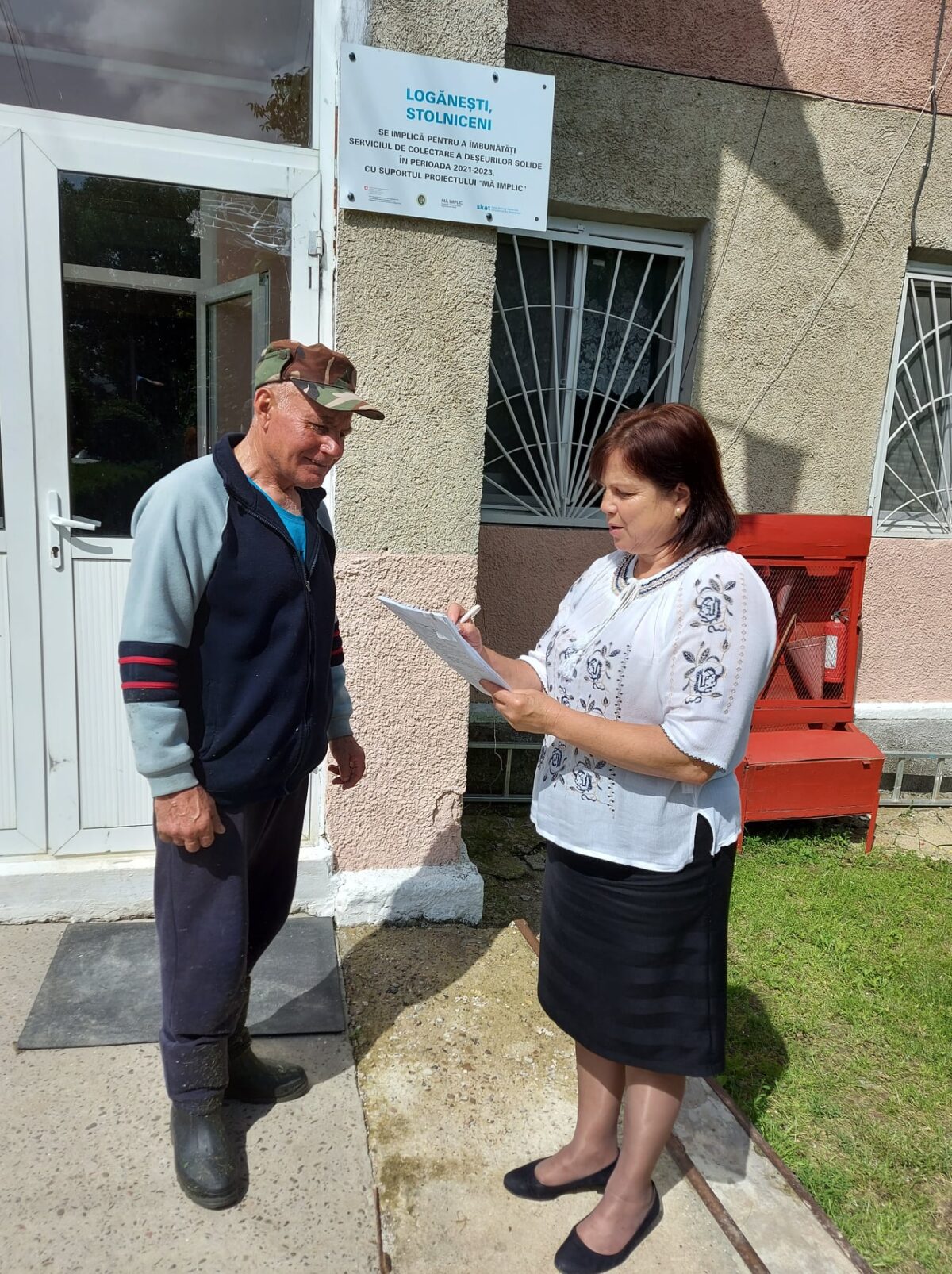
The villages of Logănești and Stolniceni will create together a modern communal solid waste collection service

The villages of Logănești and Stolniceni will create together a modern communal solid waste collection service

The citizens of Logănești and Stolniceni villages from Hâncești rayon will have access to quality communal services, thanks to the partnership with the “MĂ IMPLIC” project.

Until now, the 6,000 citizens could not benefit from a communal solid waste collection service, being forced to transport the garbage from the households to the two unauthorized landfills near the villages. According to the latest community surveys, citizens want to have access to quality communal services, to have decent living conditions, aligned with European standards, in a clean and healthy environment.
“We want to benefit from a communal solid waste collection service, to minimize the amount of garbage, to arrange and authorize a single landfill for both localities. Most importantly, we aim to collect waste separately, to sort recyclable waste and especially biodegradable waste. Moreover, we intend to arrange compost areas, and the compost obtained to be given for use to local farmers. We are happy that the most active participants in community meetings are the young people, those who promote progress, innovation and come with good practices observed abroad “, says Ms. Daria Gonța, leader of the Association of Natives of Logănești “DOR DE CASĂ”.
 
“The flora and fauna suffer extremely because of the waste thrown at random, the garbage steals more and more from our grasslands and forests. We need to be fair to ourselves and the environment in which we live, we need to reduce waste and have innovative and sustainable approaches, to reinvest in the management of a modern waste management service. Did you know that garbage dumped in unauthorized places poses a high risk of biosecurity and can lead to contamination of honey and bee families with various diseases? I want to be able to produce quality, healthy honey, to be able to grow my small business at home”, says Ion Toderaș, a young farmer, who has been practicing beekeeping for many years. Together with other farmers in the community, he partnered to practice and promote organic farming.

In the period 2021-2023, the villages of Logănești and Stolniceni will implement a project aimed to improve the solid waste management service, with the support of the Project “MĂ IMPLIC”, financed by the Swiss Agency for Development and Cooperation (SDC) and implemented by SKAT Consulting. Following the signed agreement, the municipality will benefit from funding (maximum 65,000 CHF), consulting, and capacity building services. The Project “MĂ IMPLIC” will help the municipality and the service provider not only to improve the infrastructure but also to develop long-term approaches to keep this infrastructure in good shape and to have sustainable models for financing the provision of services. In our work, we will ensure that local citizens, employees of LPAs, NGOs, economic agents are actively involved in modernizing public services in the community and especially that the less advantaged have equal access to these services.